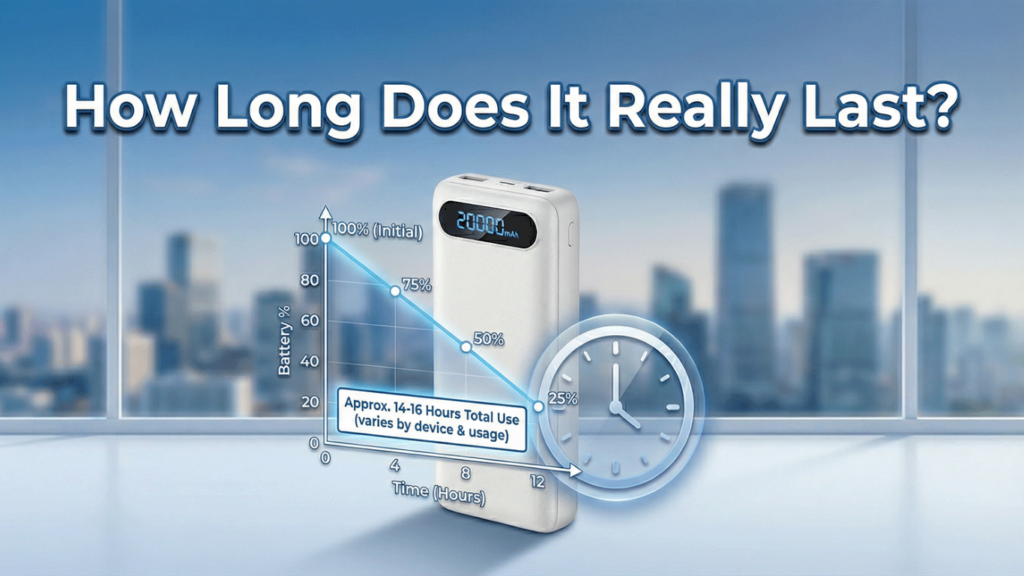
You’ve got a power bank in your bag. But how long will it actually keep your phone charged and how long before the power bank itself needs replacing?
These are two different questions, and both are worth knowing before you buy or rely on one. In this guide, we’ll answer both completely: how many charges you get per session and how many years a power bank typically lasts before it starts losing capacity.
How Long Does a Power Bank Last Per Charge?
This depends on two things: the capacity of the power bank (mAh) and the battery size of your phone.
Here’s a simple real-world guide:
| Power Bank Capacity | Typical Phone Charges |
|---|---|
| 5,000 mAh | 1 – 1.5 charges |
| 10,000 mAh | 2 – 3 charges |
| 20,000 mAh | 4 – 6 charges |
| 30,000 mAh | 6 – 8 charges |
Why not 100% efficient? Because energy is lost as heat during every charge transfer. In real-world use, expect about 70–80% efficiency from the listed capacity.
So a 10,000 mAh power bank doesn’t deliver 10,000 mAh to your phone, it delivers closer to 7,000–8,000 mAh in practice.
How to calculate for your phone
Most modern phones have batteries between 3,000 mAh and 5,000 mAh. Here’s a quick formula:
Effective mAh ÷ Phone battery size = Number of full charges
Example: 10,000 mAh power bank × 0.75 efficiency = 7,500 effective mAh ÷ 4,500 mAh (phone battery) = ~1.7 full charges
How Long Does a Power Bank Battery Last Over Time?
This is the lifespan question, how long before a power bank starts losing capacity and eventually dies?
Most quality power banks are rated for 300 to 500 full charge cycles before the battery noticeably degrades. After that, it doesn’t suddenly stop working, it just holds less charge than when it was new.
Here’s what that means in real life:
| Usage Pattern | Estimated Lifespan |
|---|---|
| Light use (1–2 charges/week) | 3 – 5 years |
| Moderate use (3–4 charges/week) | 1.5 – 3 years |
| Heavy use (daily charging) | 1 – 1.5 years |
A quality power bank from a trusted brand like Anker, Baseus, or Mophie used a few times a week should easily last 2–3 years before you notice any significant capacity drop.
Cheap, unbranded power banks often use lower-quality cells that degrade much faster, sometimes within 6–12 months of regular use.
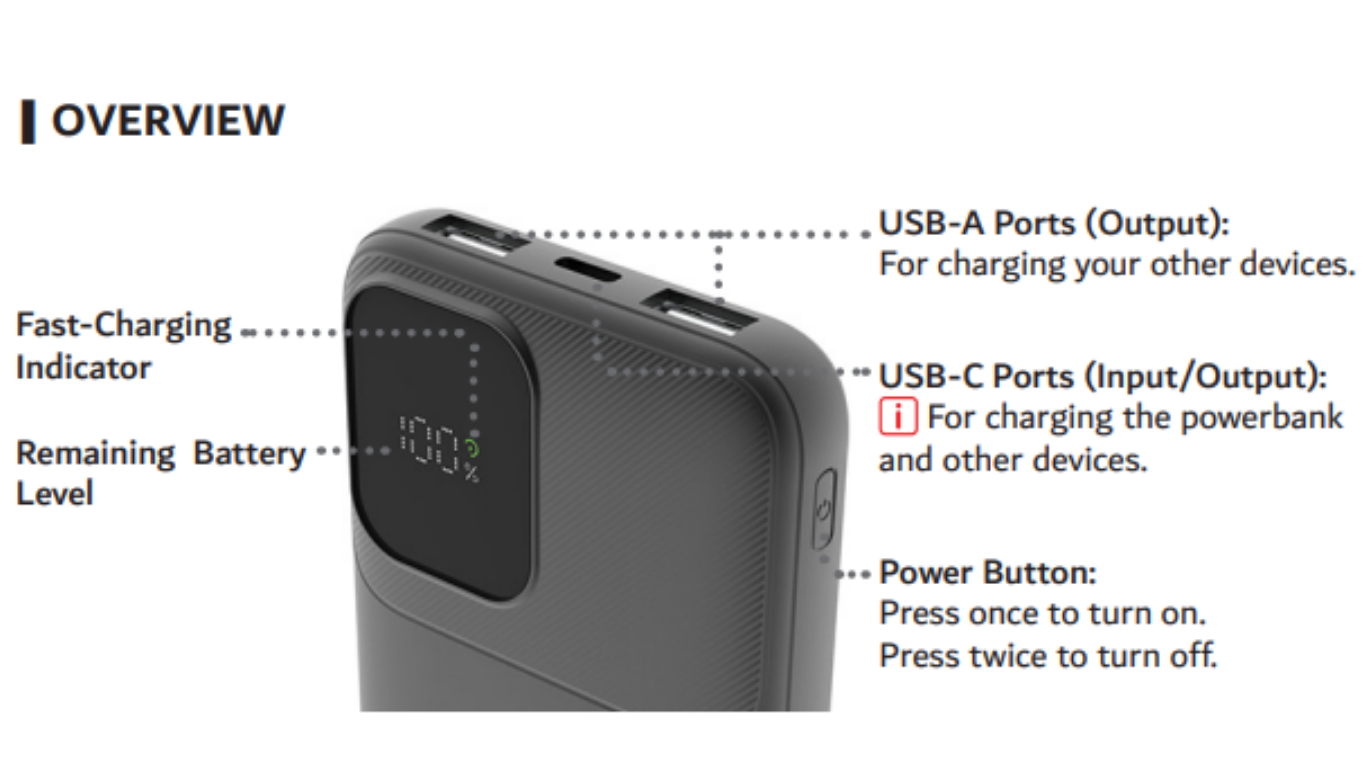
5 Things That Affect How Long a Power Bank Lasts
1. Capacity (mAh Rating)
The higher the mAh rating, the more energy is stored and the more charges you get per session. However, higher capacity also means a larger, heavier device. For everyday carry, 10,000 mAh hits the sweet spot.
2. Charging Speed and Temperature
Fast charging generates more heat, and heat is the enemy of lithium-ion batteries. Power banks that run very hot during use or charging degrade faster over time. Always charge in a cool, ventilated environment and avoid leaving your power bank in a hot car.
3. Quality of the Battery Cells Inside
Not all mAh ratings are equal. Cheap power banks use lower-grade battery cells that don’t hold charge as well and degrade faster. A 10,000 mAh budget bank might perform more like 6,000 mAh in real use. Premium brands use higher-grade cells that actually deliver close to their stated capacity.
4. How You Store It
Storing a power bank fully discharged (0%) or at 100% for long periods both damage lithium-ion batteries. For long-term storage, keep the charge level between 40% and 80%. Check and top it up every 3 months if you’re not using it regularly.
5. Number of Charge Cycles Used
Every full charge and discharge counts as one cycle. Budget power banks handle around 300 cycles before noticing real capacity loss. Premium brands handle 500+ cycles. If you charge your power bank every day, you’ll use up those cycles much faster than someone who charges it twice a week.
How to Make Your Power Bank Last Longer
Follow these simple habits to extend your power bank’s lifespan significantly:
- Don’t let it fully drain to 0%: partial discharges are gentler on the battery than full discharges. Try to recharge it when it hits around 20%.
- Don’t leave it plugged in after it’s fully charged: overcharging strains the battery. Most modern power banks have protection circuits, but it’s still better practice to unplug when full.
- Avoid extreme temperatures: don’t leave it in a hot car, direct sunlight, or freezing conditions. Room temperature is ideal.
- Store at partial charge when not in use: 40–80% is the sweet spot for long-term storage.
- Use the included cable or a quality cable: cheap cables can cause inconsistent power delivery that stresses the battery.
- Don’t use it while it’s charging itself: this “pass-through charging” generates extra heat and degrades the battery faster.
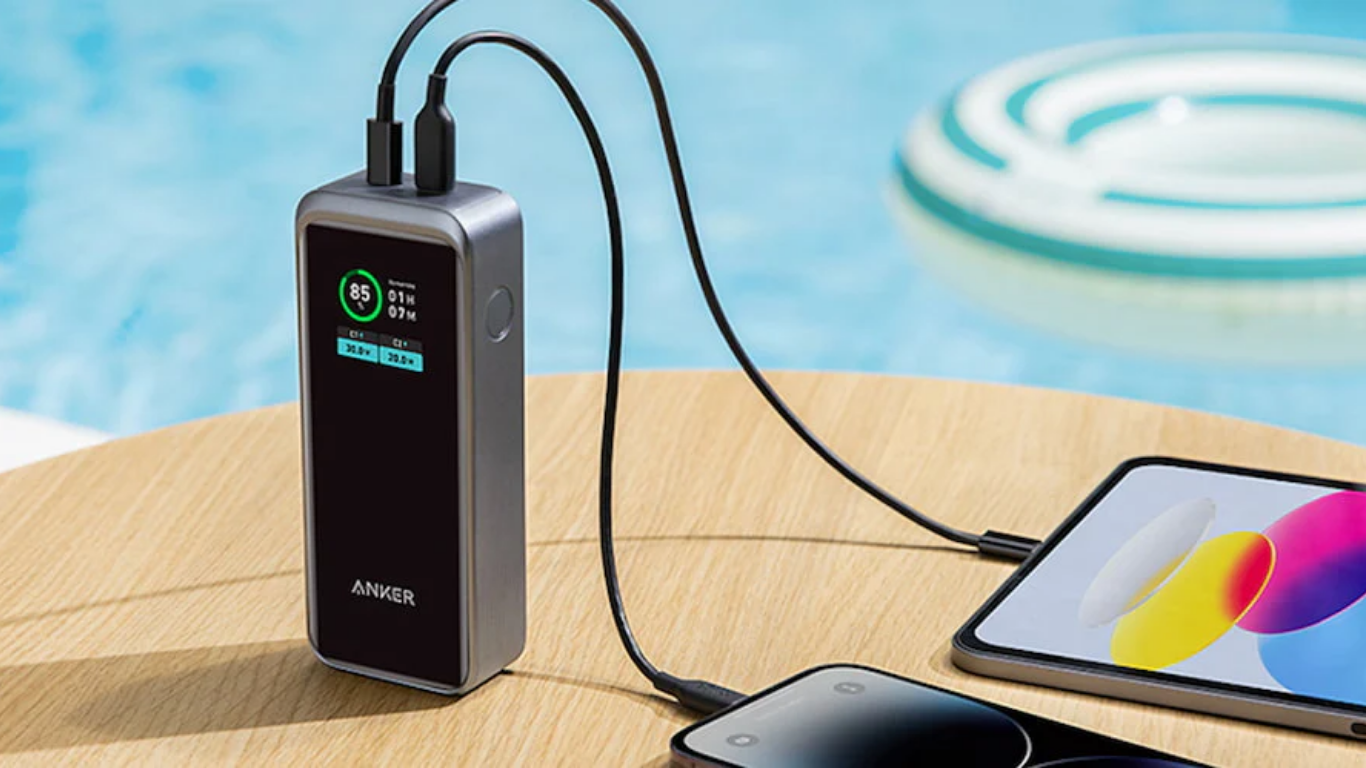
How Do You Know When a Power Bank is Dying?
Watch out for these signs that your power bank is approaching the end of its useful life:
- Charges your phone less than it used to: if your 10,000 mAh bank now only gives you one full charge instead of two, capacity has degraded significantly.
- Gets very hot during use or charging: excessive heat is a sign of battery degradation.
- Takes much longer to charge itself: a dying battery charges slowly and inefficiently.
- Indicator lights behave strangely: flickering or incorrect battery level readings.
- Swelling or unusual shape: this is a safety concern. If your power bank looks swollen or bloated, stop using it immediately and dispose of it safely at an electronics recycling point.
Power Bank Lifespan by Brand Quality
| Brand Tier | Example Brands | Expected Lifespan |
|---|---|---|
| Premium | Anker, Mophie, Belkin | 3–5 years |
| Mid-range | Baseus, RAVPower, Xiaomi | 2–3 years |
| Budget | Unknown brands, market generics | 6 months – 1.5 years |
Spending an extra $10–$15 on a mid-range brand over a budget option typically doubles your power bank’s lifespan making it better value overall.
Who Needs a High-Capacity Power Bank?
- Travellers on long flights: a 20,000 mAh bank gives you multiple phone charges and can even charge tablets.
- Festival and event-goers: a full-day outdoor event with heavy phone use needs at least 10,000 mAh.
- Remote workers and students: charging on the go throughout a full workday.
- Campers and hikers: away from power for multiple days? Go for 20,000–30,000 mAh.
For everyday commuters and casual users, a 10,000 mAh power bank is the ideal balance of size, weight, and capacity.
Frequently Asked Questions
Q: How many times can I charge my phone with a 10,000 mAh power bank?
A: With real-world efficiency, a 10,000 mAh power bank delivers about 7,000–8,000 mAh usable charge. For a phone with a 4,000 mAh battery, that’s roughly 1.7–2 full charges.
Q: Can a power bank last for years without being used?
A: Lithium-ion batteries degrade slowly even when not in use, losing about 1–2% capacity per month in storage. Keep it stored at 40–80% charge and check it every few months.
Q: Is it bad to leave a power bank plugged in overnight?
A: Most modern power banks have overcharge protection that stops charging when full. However, repeatedly leaving it plugged in overnight is still slightly stressful for the battery. Unplug when full when possible.
Q: How long does it take to fully charge a power bank?
A: A 10,000 mAh bank takes 2–4 hours with a fast charger. A 20,000 mAh bank takes 5–8 hours on a standard charger, or 3–4 hours with a 45W+ fast charger.
Q: What happens if I drop my power bank?
A: Minor drops are usually fine. A hard drop on a corner can damage internal cells and cause abnormal behaviour. If the power bank gets very hot after being dropped, stop using it.
Q: Can I take a power bank on a flight?
A: Yes, in carry-on luggage only. Airlines typically allow power banks up to 100Wh (about 27,000 mAh). Banks over 100Wh and up to 160Wh need airline approval. Always check before flying.
Conclusion
So, how long does a power bank last? For a single session, a 10,000 mAh bank gives you 2–3 phone charges. For overall lifespan, a quality power bank used a few times a week should serve you well for 2–3 years before capacity noticeably drops.
Buy from a trusted brand, store it at partial charge when not in use, keep it away from heat, and it’ll be a reliable travel companion for years to come.
Also read: What is a Power Bank? Complete Beginner’s Guide | What is eSIM? The Complete Beginner’s Guide
How old is your power bank and how is it holding up? Share in the comments, we’d love to hear!