Millions of people are switching from Google to Perplexity AI or at least using both. But is Perplexity AI actually better than Google, or is it just hype?
This is one of the most searched questions in tech right now, and the honest answer is: it depends on what you’re searching for. In this guide, we break down exactly when Perplexity beats Google, when Google beats Perplexity, and which one you should use for different tasks.
Is Perplexity AI Better Than Google?
For some tasks yes, genuinely better. For others no, Google is still the smarter choice.
The fundamental difference is this:
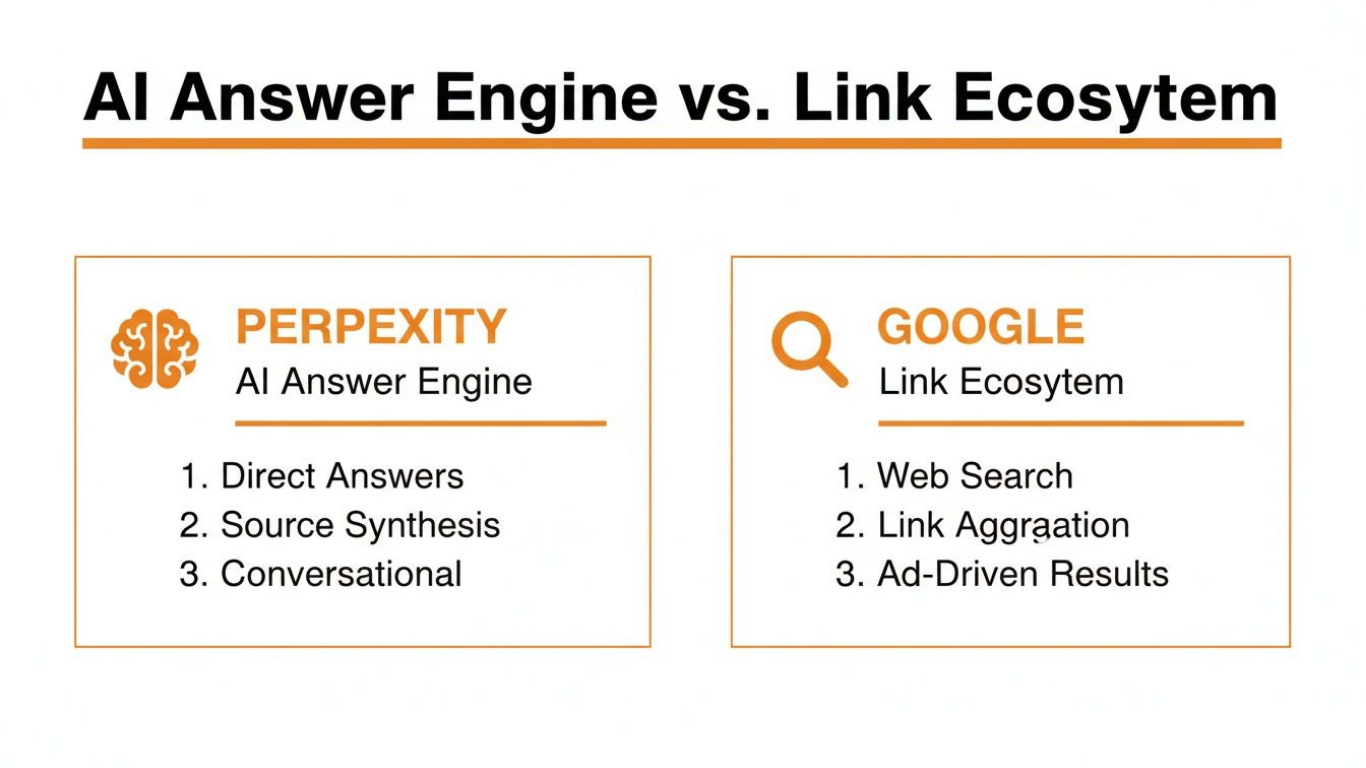
- Google shows you a list of links and lets you decide which to click and read.
- Perplexity AI reads those websites for you and gives you a direct answer with the sources cited.
Neither is universally better. They solve search differently and understanding that difference is what helps you get better results from both.
How They Work Differently
Google Search:
- You type a query
- Google’s algorithm ranks billions of pages by relevance
- You see a list of links (plus ads, featured snippets, shopping results)
- You click, read, come back, click again, compare
- You piece together the answer yourself
Perplexity AI:
- You type a question in natural, conversational language
- Perplexity searches the live web in real time
- It reads the top sources for you
- It writes a clear, summarised answer with numbered source citations
- You see the answer immediately with links to verify everything
For research questions, informational queries, and anything where you want a direct answer Perplexity is faster and less work.
When Perplexity AI is Better Than Google
1. Research and Informational Queries
Asking “what are the effects of sleep deprivation on productivity?” on Google gives you a list of health websites to click through. Perplexity gives you a synthesised, cited answer in 10 seconds.
For any question where you want a summary of what the internet says rather than a list of pages to browse Perplexity wins.
2. No Ads in the Results
Google’s search results are increasingly filled with sponsored links at the top. When you search for products, the first 3–5 results are often paid ads. Perplexity has no advertising in its answers results are purely based on relevance.
3. Complex Multi-Part Questions
“What’s the difference between a Roth IRA and a traditional IRA, and which is better for someone in their 30s earning $80,000 per year?” Google gives you 10 tabs to open. Perplexity gives you a complete, structured answer.
4. Current Events and Recent News
Both tools search the live web, but Perplexity presents news summaries with source links in a much cleaner format than Google News.
5. Academic and Research Tasks
Perplexity’s Academic mode filters results to peer-reviewed papers and scholarly sources. For students writing essays or researchers verifying facts, this is genuinely useful.
When Google is Still Better Than Perplexity AI
1. Local Searches
“Pizza near me”, “pharmacies open now”, “best dentist in [city]” Google Maps integration is unbeatable for local search. Perplexity has no local map results or real-time business listings.
2. Shopping and Product Searches
Google Shopping shows you prices, images, availability, and merchant comparisons across hundreds of stores. Perplexity can tell you about products but can’t show live inventory or pricing in the same way.
3. Image and Video Search
Google Images and Google Videos are dedicated tools that Perplexity simply doesn’t match. If you’re looking for visual content, stick with Google.
4. Navigating to Specific Websites
If you’re searching “Facebook login” or “BBC weather” you want a direct link. Google is faster for navigational searches where you know exactly where you want to go.
5. Very Broad Discovery Searches
Browsing for ideas, inspiration, or general exploration “best Italian restaurants in Rome”, “places to visit in Japan” sometimes the variety of Google’s results is exactly what you want. Seeing 10 different perspectives in link form helps with discovery.
Head-to-Head Feature Comparison
| Feature | Perplexity AI | Google Search |
|---|---|---|
| Direct answers | ✅ Always | ⭐ Featured snippets only |
| Cited sources | ✅ Always | ❌ Not standard |
| Ads in results | ❌ None | ✅ Many |
| Real-time web | ✅ Yes | ✅ Yes |
| Local search / maps | ❌ Limited | ✅ Excellent |
| Image search | ❌ Limited | ✅ Excellent |
| Video search | ❌ Limited | ✅ Excellent |
| Shopping search | ❌ Limited | ✅ Excellent |
| Follow-up questions | ✅ Conversational | ❌ New search needed |
| Academic mode | ✅ Yes | ❌ No |
| Privacy | ⭐ Better than Google | ⭐ Tracks extensively |
| Free to use | ✅ Yes | ✅ Yes |
| Mobile app | ✅ iOS + Android | ✅ iOS + Android |
Accuracy: Which One Gets Facts Right?
Both tools can be wrong. Here’s the honest truth:
Google ranks pages by authority and relevance meaning a high-ranking result might still contain outdated or incorrect information. Google itself rarely makes factual claims; it just surfaces content from others.
Perplexity synthesises information from multiple sources and provides citations so you can verify every claim. However, because it’s an AI summarising content, it can occasionally misrepresent a source or combine information in a slightly inaccurate way.
Best practice: Use Perplexity for the answer, then click the source links to verify any important facts. This two-step approach gives you the speed of Perplexity with the verification ability of reading primary sources.
Speed: Which is Faster?
For getting a useful answer, Perplexity is faster.
A Google search in 0.5 seconds gives you links. You still need to click, read, and process. Total time to answer: 2–10 minutes for research questions.
Perplexity takes 3–8 seconds to generate a response. But that response IS the answer. Total time: under 10 seconds.
For simple navigational searches (“Facebook” or “BBC News”), Google wins on pure speed. For research and informational queries, Perplexity delivers faster useful outcomes.
Should You Switch from Google to Perplexity?
You don’t have to choose. Most power users use both switching based on the task:
Use Perplexity for:
- Research and informational questions
- Summarising news and current events
- Academic research
- Comparing products or ideas
- Any question where you want a direct answer
Use Google for:
- Finding local businesses and places
- Shopping for products with price comparisons
- Image and video searches
- Navigating to specific websites
- Quick link lookups
How Much Does Each Cost?
| Tool | Free Plan | Paid Plan |
|---|---|---|
| Perplexity AI | ✅ Generous free tier | Pro: $20/month |
| Google Search | ✅ Always free | N/A |
Google is free and always will be (supported by advertising). Perplexity’s free plan is genuinely useful most people won’t need to pay. The $20/month Pro plan unlocks faster AI models, file uploads, and more daily searches.
Frequently Asked Questions
Q: Is Perplexity AI free to use?
A: Yes. The free tier includes unlimited standard searches with real-time web access and cited answers. The Pro plan at $20/month adds more powerful AI models.
Q: Does Perplexity AI replace Google?
A: For many research and informational searches, yes. But Google remains better for local search, shopping, images, and navigation. Most people use both.
Q: Is Perplexity AI more private than Google?
A: Perplexity collects less personal data for advertising purposes than Google, which tracks your searches extensively. However, both collect some usage data.
Q: Can Perplexity AI make mistakes?
A: Yes. Like all AI tools, it can occasionally misinterpret sources or make errors. Always check the cited sources for important information.
Q: Does Google have an AI search tool?
A: Yes, Google’s AI Overviews (formerly Search Generative Experience) now shows AI-generated summaries at the top of some search results. However, these aren’t always shown and Perplexity is more consistently answer-focused.
Q: Which is better for students, Perplexity or Google?
A: Perplexity, especially for research. Its Academic mode surfaces peer-reviewed papers, and the citation system makes it easy to find and verify sources for essays and reports.
Conclusion
Is Perplexity AI better than Google? For research, information, and direct answers – yes, Perplexity often delivers faster and cleaner results. For local search, shopping, images, and navigation Google is still the better tool.
The smartest approach in 2026 is to use both. Think of Perplexity as your research assistant and Google as your directory. Together, they cover everything.
Also read: What is Perplexity AI? The Honest Beginner’s Guide | What is Rabbit R1? The AI Gadget Everyone’s Talking About
Do you use Perplexity, Google, or both? Tell us in the comments below.