Choosing from the best AI assistant apps 2026 has to offer has never been harder, in a good way. There has never been a moment where three major AI assistants were all this capable, all at the same time. ChatGPT just got a dedicated work agent. Apple just rebuilt Siri from the ground up. Google’s Gemini is quietly powering both of those products behind the scenes while also running its own assistant experience. We spent time testing each one across everyday scenarios, from quick personal tasks to longer work projects, to help you figure out which one actually deserves a permanent spot in your daily life.

A Quick Note on How These Three Actually Overlap
Before getting into a straight comparison, it’s worth understanding something that surprises a lot of people. These three assistants aren’t as separate as their branding suggests. Apple’s newly launched Siri AI actually runs on a custom version of Google’s Gemini model, licensed through a reported billion dollar a year deal. Meanwhile, Google’s own Gemini technology also powers the AI coaching feature inside products like the Fitbit Air, extending well beyond Google’s own assistant app.
So in a real sense, this comparison is partly ChatGPT versus two different products both running on variations of Google’s underlying AI, wrapped in very different experiences by Apple and Google respectively, a dynamic we unpacked directly in ChatGPT vs Siri AI 2026: Which AI Assistant Actually Answers Better?
It’s also worth noting that ChatGPT isn’t the only general purpose AI chatbot worth knowing about. Perplexity has built a loyal following of its own by focusing heavily on cited, search grounded answers rather than open ended conversation, an approach we broke down separately when comparing it directly to Google Search. If you’re curious how a search focused AI tool stacks up against a traditional search engine, that’s worth a look alongside this comparison.

ChatGPT: The General Purpose Powerhouse
ChatGPT remains the most flexible and widely used AI assistant simply because it isn’t tied to one hardware ecosystem. It works the same whether you’re on iPhone, Android, Windows, or Mac, which matters enormously if you switch devices often or use a mix of platforms across work and home.
The biggest recent shift for ChatGPT is the arrival of ChatGPT Work, an agent that goes beyond conversation to actually produce finished documents, spreadsheets, presentations, and simple web apps. Running on the new GPT-5.6 model family, this pushes ChatGPT further into genuine task completion rather than just being a very good question answering tool.
Where ChatGPT still leads clearly: cross platform availability, depth of conversation, and now, actual project completion through ChatGPT Work.
Where it falls short: it doesn’t have the same standing access to your personal device data that a built-in assistant like Siri AI has, since you’re using a separate app rather than something woven into your operating system.
ChatGPT’s pricing structure also gives it an edge in flexibility. The free tier is genuinely usable for casual questions and everyday help, while the paid tiers scale up smoothly for anyone who wants more advanced models, higher usage limits, or access to newer tools like ChatGPT Work. That tiered approach means it fits a wider range of budgets than an assistant that’s simply bundled into expensive hardware.

Siri AI: The Deeply Personal Assistant
Apple’s Siri AI overhaul, announced at WWDC 2026, finally gave the assistant real conversational memory, a standalone app with saved chat history, and a new Visual Intelligence feature that lets it understand and answer questions about whatever’s currently on your screen or in front of your camera.
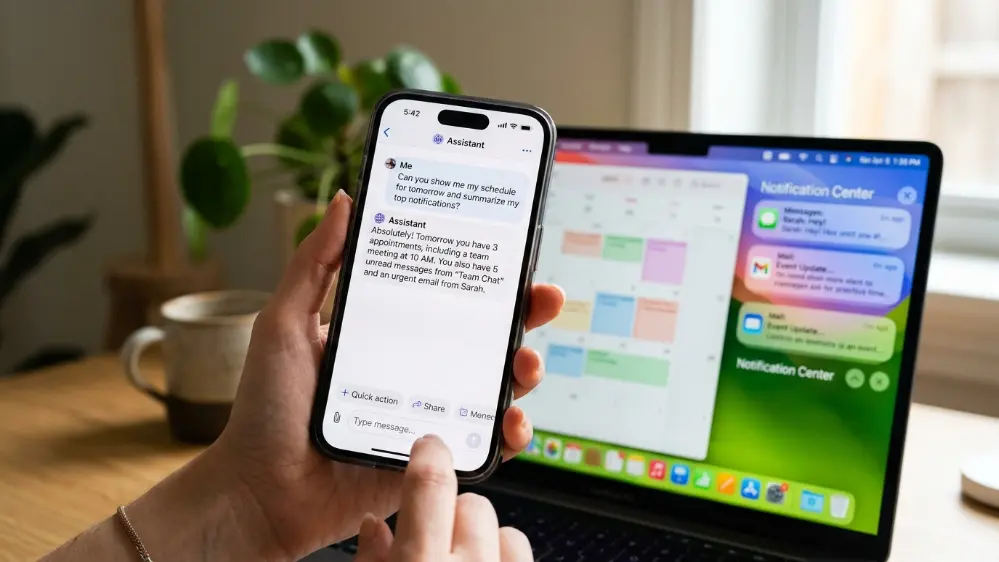
The strength here is context. Siri AI already knows your messages, your calendar, your photos, and your screen content, without you having to explain your situation from scratch. For quick, personal, device-specific tasks, that integration is genuinely hard to beat.
The tradeoffs are real too. Siri AI only works on Apple hardware, and even within Apple’s own ecosystem, it requires fairly recent devices. It’s also not available at launch in the EU or China, and it’s launching in English first, with other languages coming later.
For a full side by side breakdown against ChatGPT specifically, we covered that in detail here: ChatGPT vs Siri AI 2026: Which AI Assistant Actually Answers Better?
Beyond the headline features, Siri AI’s real advantage might be how invisible it becomes once it’s working well. Because it’s baked into the operating system rather than living in a separate app, using it doesn’t feel like switching tools the way opening ChatGPT does. That seamlessness is exactly what Apple has been chasing since it first announced Apple Intelligence, and this overhaul is the closest it’s come to actually delivering on that original vision.
Gemini: The Assistant Powering Everything Else
Google’s Gemini occupies a strange and interesting position right now. It has its own standalone assistant experience across Android and Google apps, but its bigger impact in 2026 might actually be as the engine running behind other companies’ products. It powers Apple’s Siri AI through a licensing deal, and it powers the Google Health Coach feature inside the Fitbit Air, guiding personalized fitness plans and translating raw health data into plain language advice, a feature we tested firsthand in our Fitbit Air review and compared against rivals in Fitbit Air vs Oura Ring vs Whoop.
As a standalone assistant, Gemini’s biggest strength is deep integration across Google’s own services: Gmail, Calendar, Google Drive, Search, and increasingly, Google’s health and wearable products. If your daily digital life already runs through Google’s ecosystem, Gemini tends to slot in naturally.
Where it’s less clear cut is brand identity. Because Gemini shows up in so many different places, wearing so many different names and interfaces depending on the product, it can be harder to point to one single “Gemini experience” the way you can with ChatGPT or Siri AI.
This diffusion has an upside though. Rather than needing to actively choose Gemini as your primary assistant, plenty of people are already benefiting from it indirectly, whether they realize it or not, simply by using an iPhone with Siri AI enabled or wearing a Fitbit Air with an active Health Premium subscription. In that sense, Gemini might already be the most widely used AI model on this list without most people even knowing it.
Side by Side: What Each One Is Actually Best For
If you want the most flexible tool that works everywhere and now handles real task completion through ChatGPT Work, ChatGPT is the strongest overall pick.
If you want an assistant that already knows your personal context and device content without extra setup, and you’re fully inside the Apple ecosystem, Siri AI is genuinely useful in a way it never was before.
If your life already runs through Gmail, Google Calendar, and Google’s growing health and wearable lineup, Gemini’s deep integration across those products makes it the most natural fit, even if it doesn’t always feel like one unified product. If OpenAI’s own hardware ambitions interest you, our OpenAI Jony Ive device guide covers where that project currently stands.
Pricing Snapshot Across All Three
ChatGPT offers a genuinely usable free tier, with paid plans scaling up for heavier use and access to ChatGPT Work. Siri AI comes bundled at no extra cost with qualifying Apple hardware, meaning the real cost is whatever you already paid for your iPhone, iPad, or Mac. Gemini follows a similar bundled model across Google’s own apps and devices, though certain premium features, like the Health Coach inside Fitbit Air, sit behind a separate monthly subscription once any included trial period ends.
None of these three require a dedicated standalone subscription just to use a basic version of the assistant, which is genuinely good news for anyone trying to avoid piling on more monthly software costs. The real spending decisions come down to whether you need the more advanced paid tiers for heavier or more specialized use.
The Bigger Trend Worth Noticing
Look across all three of these products and a clear pattern emerges. Every major AI assistant is racing in the same direction right now: from answering questions toward actually completing tasks on your behalf. ChatGPT Work builds documents and websites. Siri AI is inching toward agentic actions inside other apps. Gemini is already handling entire fitness coaching relationships inside products like the Fitbit Air.
None of these tools are fully “hands off” yet, and honestly, treating any of them as completely autonomous for anything important is still a little risky. But the direction is unmistakable, and 2026 looks like the year that direction became obvious to everyone, not just people paying close attention to AI news.
What to Expect Next
If the pace of the past few months is any indication, none of these three assistants are staying still for long. Apple still has agentic extensions for Siri AI on its roadmap, which would let it take real actions inside third party apps rather than just your own built in ones. OpenAI is reportedly continuing to expand ChatGPT Work’s capabilities, and given the company’s parallel hardware ambitions with the Jony Ive designed device, there’s a reasonable chance ChatGPT’s assistant capabilities eventually extend into a dedicated piece of hardware of its own. Google, meanwhile, seems intent on pushing Gemini into an ever growing list of products well beyond phones and computers, following the same pattern already visible in the Fitbit Air.
The honest takeaway is that whichever assistant you pick today, the experience is going to keep changing quickly. Revisiting this comparison in another six months would likely turn up meaningful differences from what’s true right now, which is part of what makes this such an interesting moment to be paying attention.
Frequently Asked Questions
Which AI assistant is best overall in 2026? There isn’t a single universal answer. ChatGPT offers the most flexibility across devices and the most advanced task completion tools. Siri AI offers the deepest personal context if you’re fully inside Apple’s ecosystem. Gemini offers the strongest integration if your life runs through Google’s apps and services.
Is Siri AI actually just Gemini with an Apple interface? Partly, yes. Siri AI’s conversational engine runs on a custom version of Google’s Gemini model, though Apple controls the surrounding experience, privacy handling, and on-device processing.
Can I use ChatGPT and Siri AI together? Yes. Many people use both, relying on Siri AI for quick device-specific tasks and ChatGPT for deeper conversations or generating finished work through ChatGPT Work.
Does Gemini have its own hardware device? Gemini itself is software, but it powers hardware experiences across Google’s own devices, including the AI coaching feature inside the Fitbit Air.
Which assistant is best for getting actual work done? Right now, ChatGPT has the most mature tools for this through ChatGPT Work, which can generate finished documents, spreadsheets, presentations, and simple web apps rather than just answering questions.
Is any of these three assistants completely free to use? All three have a free or bundled entry point. ChatGPT has a free tier, Siri AI comes included with qualifying Apple devices, and Gemini is included across many Google apps, though some advanced features across all three eventually require a paid tier.
Will these assistants keep changing this quickly? Almost certainly. All three companies are actively competing and shipping new features on a near monthly basis, so expect meaningful changes to continue throughout the rest of 2026 and beyond.